
Pages

Showing posts with label telemundo. Show all posts

Monday, October 4, 2010

Novelas and...Horses?


Photo Credit: Trey Ratcliff, Stuck in Customs (Flickr)


If the title to this blog seems a little weird, let me explain. 

Today, as I started watching reruns of Niña Amada Mia (2003) on TeleFutura, I realized that not only are novela writers infatuated with including horse-racing and horse-breeding as part of their plots, but audiences love horse on-screen as well. 

Assuming that morning reruns on TeleFutura are chosen on the basis of their popularity the first time they were aired, we can assume that Hispanic audiences do actually enjoy seeing wealthy people on-screen who own horses. After all, this is not the first time that a novela like this is aired on a Hispanic network.About 14 years ago Univision aired a Venezuelan production called Quirpa de Tres Mujeres (1996). "Quirpa" was the same exact story as Niña Amada Mia, except 7 years earlier and a Venezuelan cast. Thus, in both productions we watch as the protagonists--the three daughters of an important horse owner--deal with impossible love scenarios and the daily struggles of associated with being part of a horse-breeding family. 

If you're keeping count, so far we have seen two novelas somehow focused on horses.But wait,  there's more. A couple of years ago, Univision showed Niña Amada Mia for the second time. It is now 2010 and we are watching it again--a third time. 

More recently, Telemundo has also caught on with the horse love-fest in El Fantasma de Elena (2010). Not only are the protagonists, Elena Lafe and Eduardo Giron, competitive equestrians, but their families are in the horse-breeding business. Horses have become such an important part of the plot that, in a relatively recent episode, Eduardo brought the horses into the living room to take revenge for Elena's harsh behavior.

As I reflect on why horses would be included in novelas as often as they are, I figured that two potential reasons could explain this phenomenon: The first is that audiences enjoy horses (and the rural setting, for that matter) because of its potential familiarity. We must keep in mind that some--not all--Hispanic immigrants to America came from rural backgrounds. Watching the horses and the rural setting on-screen may bring back memories from their past. The second is that audiences may enjoy seeing the wealth and power associated with characters who belong to the horse-breeding elite.

Whatever it is, the truth of the matter is that horses are on-screen quite often! Do you have another idea as to why this might be so?

Thursday, September 30, 2010

When Attempts at Social Good Can Get Annoying


                                                     Photo Credit: Schmilblick (Flickr)

Yes, novelas do reach millions of viewers every day. Yes, this gives them the opportunity to influence their viewers in a positive way. But when novela writers take it upon themselves to solve the world or teach their viewers moral lesson time and time again, that’s where I draw the line.

While I have no problem seeing novelas dealing with real issues as a means to educate their audiences, I do have a problem when their good intentions ruin the plot. In the past, I have watched as novelas deal with homophobia, addictions, interracial relationships and adoption, but Telemundo’s El Clon has reached new heights with their obsession with Natalia's drug addiction.

Being an adaptation of Gloria Perez’s Brazilian novela O Clone, I was very excited about the promise of seeing something different on Hispanic television. The idea of taking an issues as controversial as cloning and interracial dating and bringing it to the (Hispanic) masses was refreshing—especially considering that most novelas still follow the traditional pattern of poor girl/guy falls in love with rich girl/guy but they can’t be together because of class differences or inter-family hatred.

However, recently, El Clon has focused on showing us, the viewers, the negative effects of drug addiction. Natalia, a supporting character in the plot, has recently become the focus of the novela as we are constantly exposed to her struggles living as a drug addict. Not only that, but we also constantly hear the Don Enrique’s words of wisdom on the topic, as he has become some sort of spokesperson for the novela’s addicts (Natlia and her group of friends), narrating the struggles that are common to people with such condition. The irony is that he is also an alcoholic who is struggling to overcome his addiction.

I do not mean to delegitimize the condition or the struggles faced by real-life addicts. Addictions must be very damaging not only to the addicts themselves to but also to their friends and family members. However, seeing it repeatedly on my television screen is annoying.

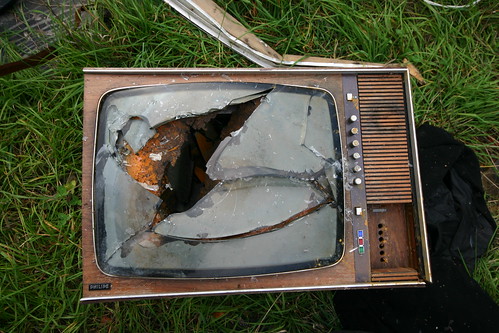
Although I support the potential television has to start serious discussions, I am annoyed at the way novelas can become obsessed with certain issues and make them an increasingly important part of the plot. What’s worse is that they try to portray these issues so seriously that they end up being unnecessarily dramatic to the point where it becomes annoying. For example, not once, not twice, but multiple times I’ve had to watch Natalia promise her boyfriend and parents that she doesn’t have a problem while listening to Don Enrique’s voice-over that describes the denial addicts live in. Yes, it must be hard for someone going through an addiction problem, but I thought the novela was about Lucas, Jade and the clone. Why must we sit through an entire episode and watch Natalia suffer?

As writers attempt to educate their audiences about the realities of social issues through the television screen, they must seriously consider the impact those portrayals will actually have. Will they present a serious issue with respect and the necessary level of gravity or will they exaggerate to the point where viewers will want to hurl something at the tv screen?